
From:
Download PDF
Adopt to Win
How Medium-Sized Enterprises Can Win the Future Competition Through Cloud Adoption
While many companies are still assessing the impact of global disruptions, a more fundamental shift is already reshaping markets: today’s competition is technology driven.
The key to your competitiveness is no longer the efficiency of processes and operations alone – but how technologically advanced your business is.
Innovative technologies enable a whole new level of performance. They streamline operations, increase agility and resilience, and lay the groundwork for new products, services, and business models that are redefining the competitive landscape.
Yet many medium-sized businesses are still lagging – even though flexible cloud services have long offered a cost-effective, low-risk entry point.
The smartest companies don’t wait. They adopt a step-by-step approach that generates immediate value while simultaneously building long-term capabilities.
What You’ll Learn in This Article
Discover why the cloud is now far more than an IT decision, what tangible results best-practice companies are already achieving, and how medium-sized firms can manage the transition in three distinct implementation phases – without overextending, and with measurable value at every stage.
If you want to future-proof your business and stay technologically relevant – this is the right place to start.
Medium-Sized Businesses are Lagging in Cloud Adoption
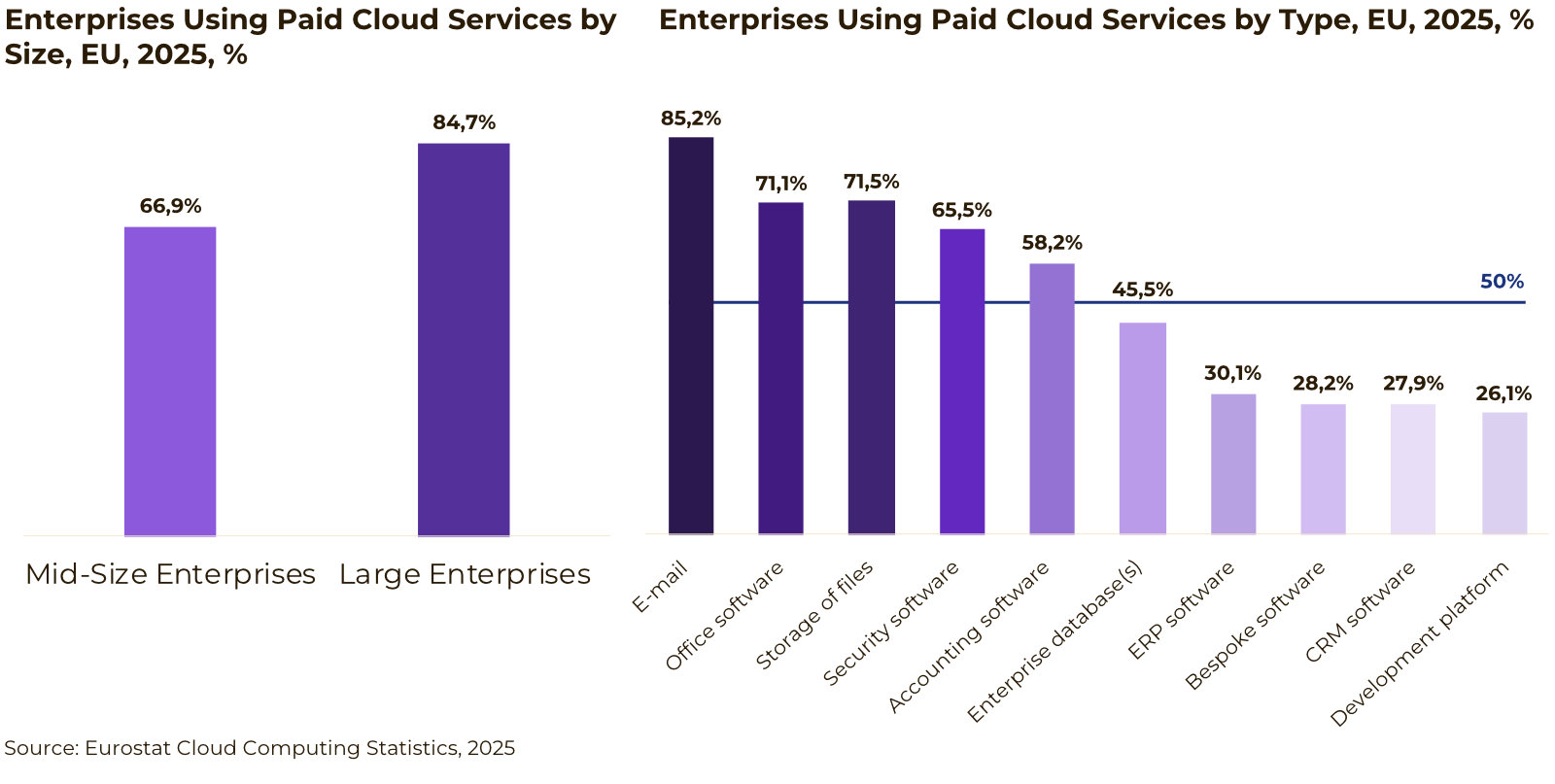
The numbers tell a clear story: only 67% of medium-sized enterprises in Europe use paid cloud services – compared to 85% of large enterprises that already rely on cloud technologies.
But the real gap lies beneath the surface. Most core applications and development environments across Europe are still running on premises, while workspace, security, and accounting tools have already moved to the cloud.
This is where the greatest untapped potential lies. Migrating core systems is the decisive step: costs drop significantly, downtime and security risks are minimized – and a powerful foundation for entirely new forms of innovation is established.
67 %
of Small and Medium-Sized Enterprises in Europe Use Paid Cloud Services
<50%
of Medium-Sized Enterprises in Europe Run Their Core Applications in the Cloud
Exhibit 1: Low Cloud Adoption Among Medium-Sized Businesses and For Core Cloud Services, %
Cloud Is More Than Infrastructure – It Drives Efficiency, Innovation, and Value
Cloud migration is too often viewed as a purely technical infrastructure project. It is one of the most powerful business value drivers available to medium-sized enterprises today.
The benchmarks are impressive:
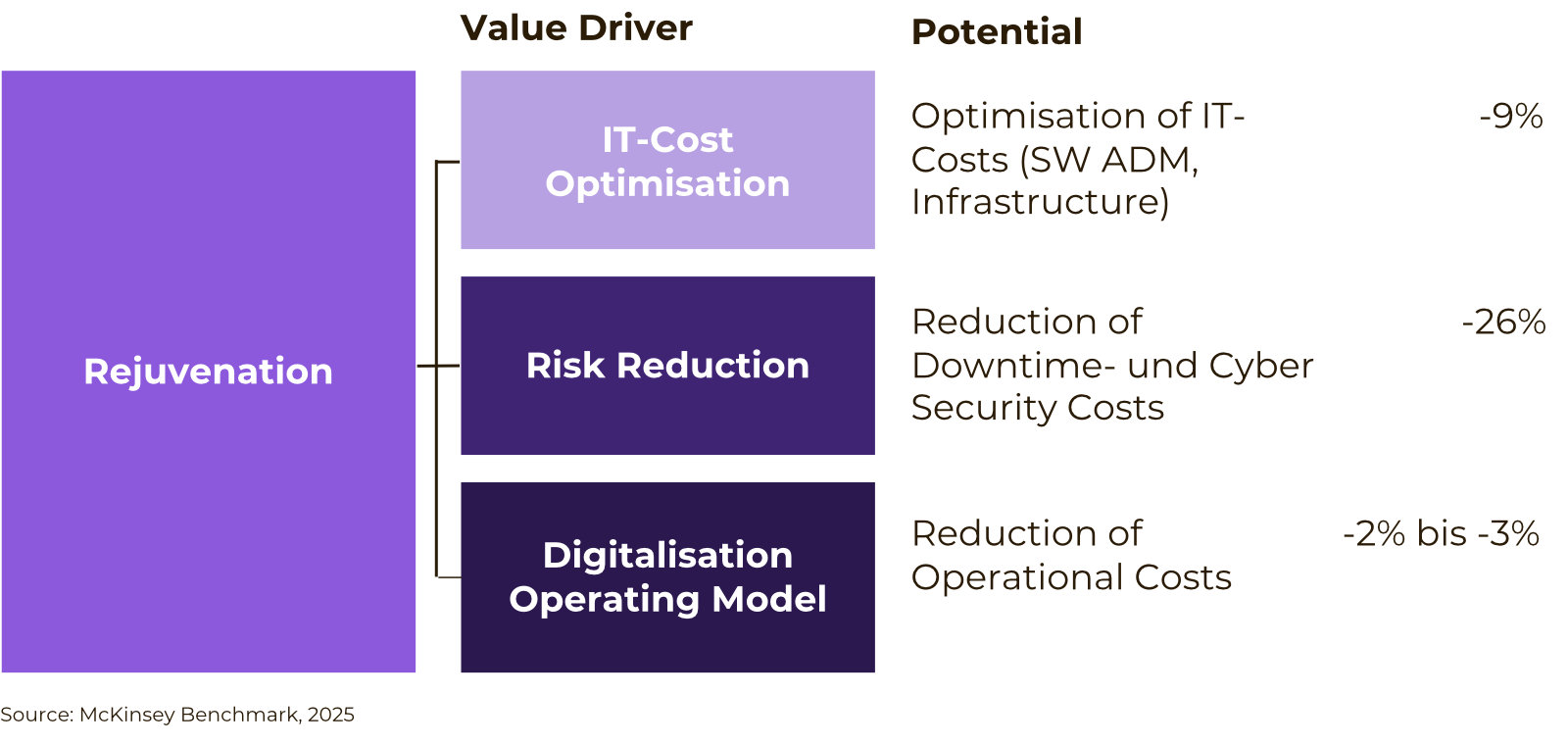
IT costs drop by an average of ~9%
Operational costs decrease by a further2–3%
Downtime and security costs fall by an average of 26%
But these gains are not simply the result of moving servers. They stem from an entirely new cloud operating model: elasticity, usage-based scaling, and automated control deliver significantly greater efficiency across the board. The optimisation of migrated applications and data – combined with the digitisation of core operations – amplifies these effects further.
The bottom line: cloud migration doesn’t just reduce costs. It fundamentally transforms how a business operates.
9 %
Reduction of IT Costs
2–3 %
Reduction of Operating
Costs
26 %
Reduction in Downtime
and Security Costs
Exhibit 2: Significant Cost Reduction Through Cloud Migration
Quick Tip
Most companies leave the greatest benefits on the table by treating the cloud as nothing more than hosting. It isn’t. The cloud creates the foundation for a fundamentally different – and more powerful – way of running your business.
Why Modernization Is More Important Than Migration
A simple “lift-and-shift” – moving existing systems into a cloud environment without transformation – unlocks only a fraction of the available potential. Best-practice companies go further: they modernize their applications and data at scale, achieving an impressive average ROI of 344% over three years.
The cloud reaches its full potential when companies also adopt the underlying methodologies: auto-scaling, automated performance management, cloud-native architecture, and deep technological integration across the entire value chain.
344 %
ROI over 3 Years
Innovation Accelerates When You Turn Data into Value
Beyond cost savings, the cloud’s greatest advantage is its capacity to drive innovation – across two distinct dimensions: the creation of new products and services with higher margins, and the development of innovative operational solutions that significantly reduce running costs.
At the heart of this is data. Successful companies don’t just tap into publicly available data – they unlock the power of their own proprietary data from core systems.
The cloud makes this data usable, accessible, and integrable, transforming it into the foundation for entirely new forms of value creation.
Tools like AWS Machine Learning Services illustrate what becomes possible when data, cloud infrastructure, and AI converge.
Example
AWS Machine Learning Services
https://aws.amazon.com/machine-learning/

In the New Competition, Speed Decides
Companies with strong cloud capabilities operate at a fundamentally different speed.
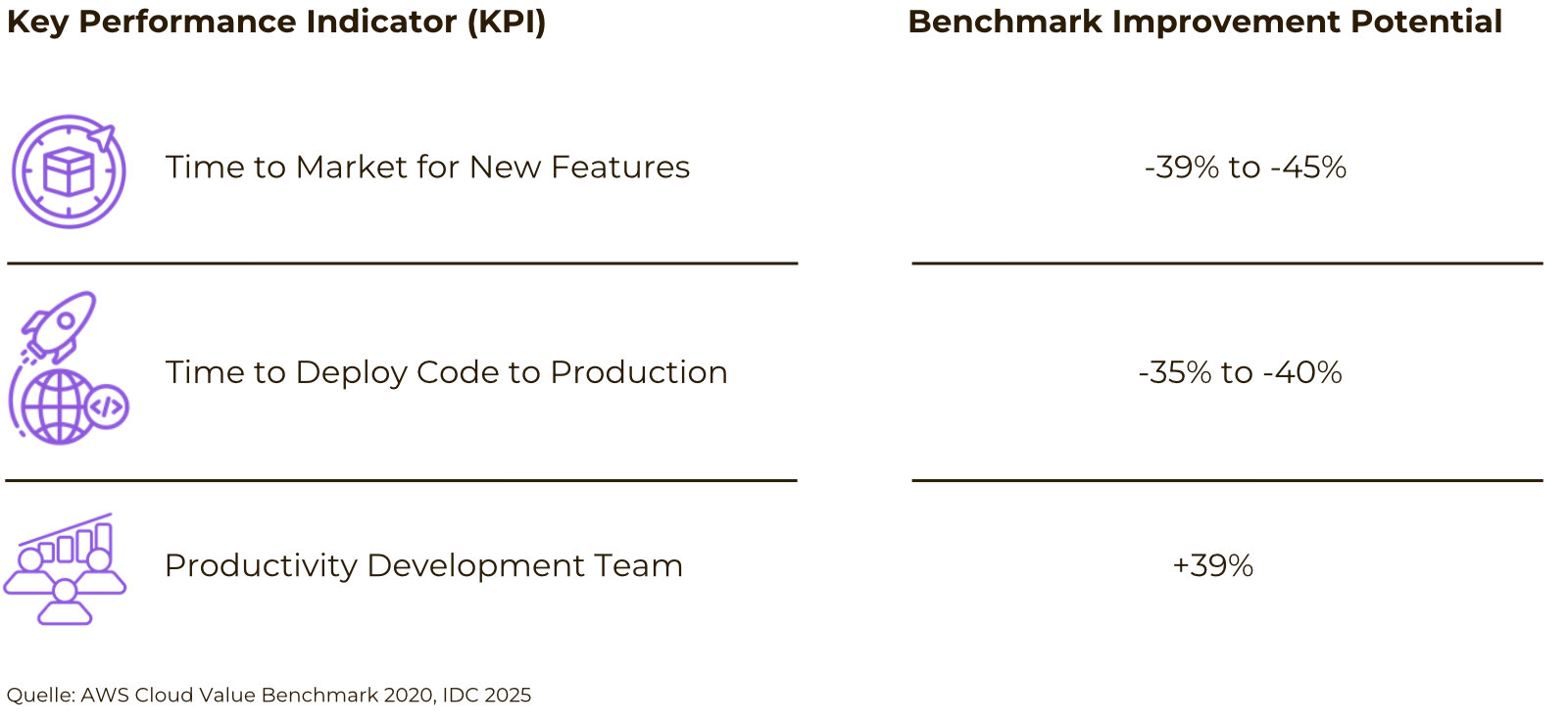
Agile development of cloud-hosted systems – particularly with DevOps – delivers measurable, decisive advantages:
Time-to-market for new features reduced by 35–45%
Time-to-deploy accelerated by 35–40%
Development team productivity increased by ~39%
In dynamic markets, this speed is not just an operational metric – it is a direct competitive advantage. Whoever delivers faster, wins market share.
35–45 %
Reduction of Time to Market for New Features
35–40 %
Reduction of Time
to Deploy
39 %
Increasing Productivity
of Development Teams
Exhibit 3: Improvement in Organizational Agility, %
How long does it take your business today to turn an idea into a release?
Resilience is a strategic factor.Beyond efficiency, agility, and innovation, the cloud delivers a fourth critical advantage: operational resilience.
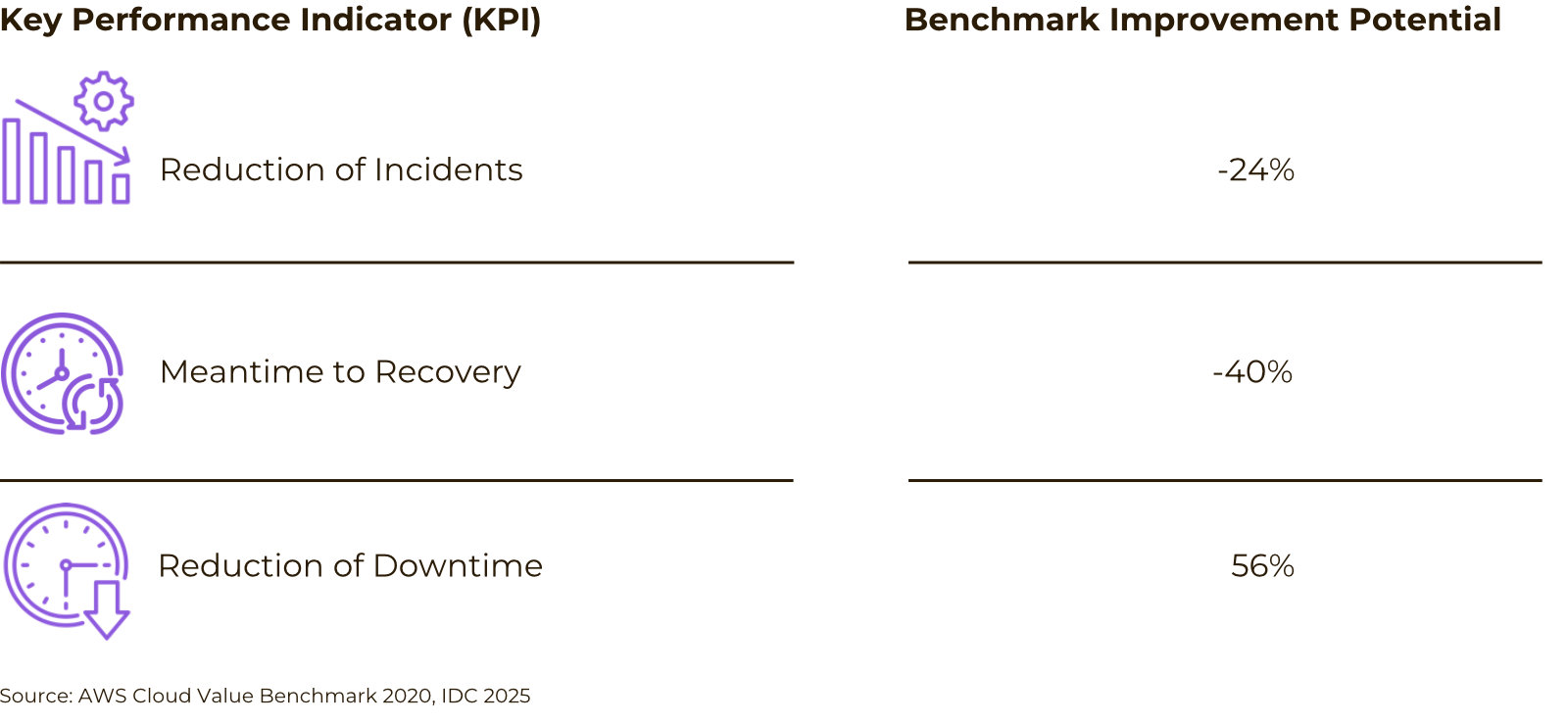
Companies that follow cloud best practices reduce incidents by an average of ~24% – with critical and security-related incidents falling even more sharply.
The impact on recovery is equally striking:
Mean Time to Recovery (MTTR) improves by nearly 40%
Overall downtime reduces by more than 56%
In an era where digital availability is directly linked to revenue, resilience is no longer an IT metric. It is a strategic business imperative.
24 %
Reduction in Workplace Incidents
40 %
Improvement in Mean Time to Recovery
56 %
Reduction in Downtime
Exhibit 4: Strengthening Organizational Resilience
How are you protecting your business from incidents and outages today?
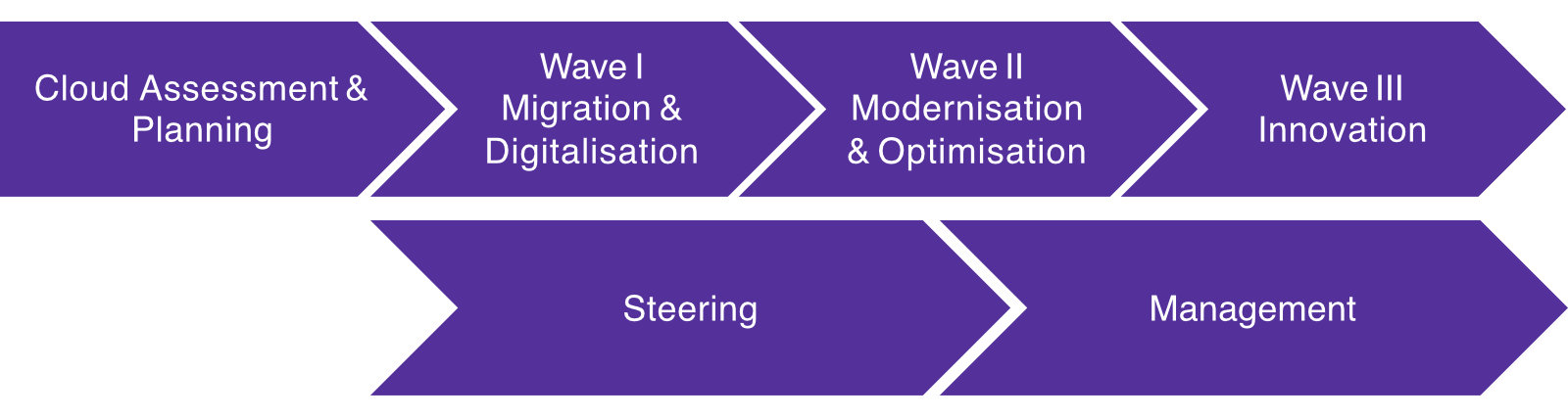
Three Phases. One Clear Path to the Cloud
For medium-sized companies, the right approach is one that generates value at every step while simultaneously minimizing implementation risk. A proven model achieves this through three distinct phases:
Phase 1 – Cloud Migration & Core Digitisation
Migrate core systems and digitise fundamental operations. From day one, the impact is tangible: IT costs drop, operating costs decrease, and security and downtime risks are significantly reduced.
Phase 2 – Modernisation & Optimisation
Migrated data and applications are modernised and optimised. Variable costs fall further – while simultaneously laying the foundation for cloud-based innovation.
Phase 3 – Innovation & Value Creation
The transformation reaches full momentum. New, cutting-edge products and services are launched, innovative operating model elements are implemented, and technology-driven value creation is systematically built and scaled.
The logic is clear: each phase delivers measurable results before the next begins. No overextension. No leap of faith. Just structured progress – with value at every stage.
Exhibit 5: Cloud Adoption Approach That Generates Value and Minimises Risk
The Cloud Is the Most Efficient, Low-Risk Path into Technology-Driven Competition
For medium-sized enterprises that consistently leverage technology and best practices, the cloud delivers transformative value – across efficiency, agility, resilience, and innovation. A clearly defined migration strategy and close alignment between IT and business leadership are essential to realizing it.
The conclusion is unambiguous: the cloud is not an IT decision. It is a strategic business decision – and the foundation for efficiency, agility, resilience, and innovation. Not just to keep pace with technology-driven competition. But to win it.
Your next step
Ready to find out which migration approach is right for your business?
Book your no-obligation cloud strategy consultation now
Want to stay ahead of the curve?
Subscribe to our newsletter – strategy, transformation best practices, and actionable insights, delivered directly to you.
The Question Is No Longer Who Will Enter the Competition – But Who Will Win It.
The race for technology-driven leadership is well underway.
The question was never whether new technologies would reshape competition. The only question that matters now is this: will you meet that change from a position of threat – or opportunity?